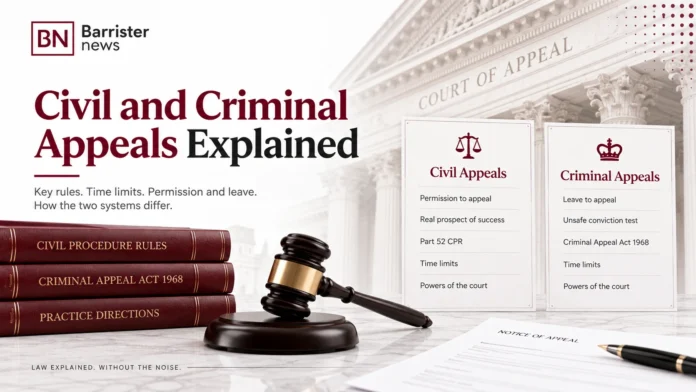


An appeal is not a second trial. In civil proceedings it is generally a review of the decision below, not a rehearing, and permission is required in almost every case. In criminal proceedings from the Crown Court, leave is required and the single question for the court is whether the conviction is unsafe.
The two regimes share a vocabulary and almost nothing else. The time limits differ, the tests differ, the powers differ, and conflating them is the most common error made by anyone approaching appellate work from one side of the profession only. What follows sets out each in turn.
Civil appeals: CPR Part 52
Civil appeals in the County Court, the High Court and the Court of Appeal (Civil Division) are governed by Part 52 of the Civil Procedure Rules, supplemented by Practice Directions 52A to 52E. Part 52 was substantially rewritten in 2016 and applies to appeals where the appellant’s notice was issued on or after 3 October 2016.
Permission
Permission to appeal is required in virtually all civil appeals. It may be granted by the lower court at the hearing at which the decision is made, or by the appeal court on application. The test is whether the appeal would have a real prospect of success, or there is some other compelling reason for it to be heard.
Second appeals are harder, and deliberately so. Where a decision was itself made on appeal, permission may be granted only by the Court of Appeal, and since the 2016 rewrite the appellant must show both that the appeal would raise an important point of principle or practice and that it would have a real prospect of success. Before that change the first limb stood alone. The alternative route remains some other compelling reason.
Applications to an appeal court other than the Court of Appeal are decided without a hearing, though a party refused on paper retains a qualified right to request an oral rehearing. That right falls away where the judge certifies the application as totally without merit.
Time limits
The appellant’s notice must be filed at the appeal court within the period directed by the lower court, which may be longer or shorter, or where no direction is made, within 21 days after the date of the decision the appellant wishes to appeal. It must be served on each respondent as soon as practicable and in any event within 7 days of filing. A respondent’s notice is filed within 14 days.
Two points catch practitioners out. Time runs from the date of the decision, not from the date the lower court refuses permission, so an application for permission below does not extend the period. And an application to extend time made after the period has expired is itself an application for relief that the court may refuse.
Where permission is sought from the Court of Appeal to appeal to the Supreme Court, the application is made within 28 days of the Court of Appeal’s decision.
The nature of the hearing
An appeal is limited to a review of the decision of the lower court. It proceeds as a rehearing only where a Practice Direction so provides or where the appeal court considers that it would be in the interests of justice. Fresh evidence is admitted only in limited circumstances, including where the evidence could not have been obtained with reasonable diligence for use below.
The appeal succeeds where the decision of the lower court was wrong, or was unjust because of a serious procedural or other irregularity in the proceedings below.
Findings of fact are the hardest target. The appellate court has not seen the witnesses, and the review model means it is not retaking the decision. Advocates who pitch an appeal as a disagreement with the judge’s assessment of the evidence generally fail, which is why the skeleton argument on an appeal has to identify an error rather than an alternative view.
Powers
The appeal court may affirm, set aside or vary any order or judgment of the lower court, refer any claim or issue back for determination, order a new trial or hearing, make orders as to interest, and make costs orders. It may also strike out an appeal notice, or set aside or impose conditions on permission already granted.
Criminal appeals from the Crown Court
Appeals against conviction on indictment lie to the Court of Appeal (Criminal Division) under the Criminal Appeal Act 1968. The Criminal Division is one of the two divisions of the Court of Appeal, constituted under section 3 of the Senior Courts Act 1981.
Leave
A person convicted on indictment may appeal against conviction under section 1 of the 1968 Act. Leave is required, unless the trial judge certifies the case fit for appeal. Applications are made within 28 days of conviction, with sentence appeals running from the date of sentence.
The application is considered first by a single judge of the Court of Appeal on the papers. If leave is refused, the applicant may renew the application to the full court. Where leave is granted on specified grounds, argument on other grounds requires further leave. The renewal route carries risk: the court retains the power to make a loss of time order where an application is renewed without merit.
The test
Section 2 of the 1968 Act, as substituted by the Criminal Appeal Act 1995, provides that the court shall allow an appeal against conviction if it thinks the conviction is unsafe, and shall dismiss the appeal in any other case.
The formulation is short and does a great deal of work. It is not a question of whether the appellant is innocent, nor whether the appellate court would itself have convicted. A conviction may be unsafe because of a misdirection, wrongly admitted or excluded evidence, a procedural irregularity, or fresh evidence, and the court considers the effect of the error on the safety of the verdict rather than the error in isolation.
Powers
Where an appeal against conviction is allowed, the court quashes the conviction, which operates as a direction for a verdict of acquittal to be entered unless a retrial is ordered. Under section 7 the court may order a retrial where it allows the appeal by reason of fresh evidence and considers that the interests of justice require it. Section 8 then requires the appellant to be arraigned on a fresh indictment within two months, and leave to arraign outside that period is granted only where the prosecution has acted with all due expedition and there is good and sufficient cause.
The court may also substitute a verdict of guilty of an alternative offence, and on sentence appeals may vary the sentence, though not so as to make the appellant more severely dealt with than below on the appellant’s own appeal.
The other criminal routes
Appeals from the magistrates’ court do not follow the same path. An appeal to the Crown Court against conviction or sentence proceeds as a full rehearing before a judge and magistrates, which is a materially different exercise from a review.
Alternatively a party may appeal by way of case stated to the High Court on the ground that the decision was wrong in law or in excess of jurisdiction, or seek judicial review. These lie to the Administrative Court rather than to the Court of Appeal Criminal Division, which is a route through a different part of the court structure entirely.
This is an area in flux. The Courts and Tribunals Bill before Parliament in 2026 would replace the automatic right of appeal from the magistrates’ court with a permission stage, so practitioners should confirm the position as it stands when advising.
Two further mechanisms sit outside the ordinary appeal structure. The Attorney General may refer a sentence to the Court of Appeal as unduly lenient in qualifying cases, which is not an appeal by the prosecution against acquittal. And the Criminal Cases Review Commission may refer a conviction or sentence to the Court of Appeal where it considers there is a real possibility that it would not be upheld, which is the principal route back to the court once ordinary appeal rights are exhausted.
Onward to the Supreme Court
From the Court of Appeal, a further appeal lies to the Supreme Court with permission. In criminal cases the court below must certify that a point of law of general public importance is involved, and permission must then be granted either by that court or by the Supreme Court. The certification requirement is a real filter: without it the Supreme Court cannot entertain the appeal however strong the argument.
Employment cases travel their own route, from the Employment Appeal Tribunal onward, and appeals there lie on a point of law only.
What the structure is for
Permission filters, time limits discipline, and the review model preserves the primacy of the trial. Each of those features exists because appellate capacity is finite and first instance decisions are made by judges who heard the evidence. An appeal that succeeds identifies an error the court below made. An appeal that merely prefers a different answer is the kind the permission stage exists to stop.
This article is information and analysis, not legal advice. Appeal routes, time limits and tests vary by jurisdiction and case type, and the position on appeals from the magistrates’ court is subject to legislation before Parliament. Confirm the current rules before acting.
Frequently asked questions
Do you always need permission to appeal?
In civil proceedings, permission is required in virtually all appeals under CPR Part 52, from either the lower court or the appeal court. In criminal appeals from the Crown Court, leave is required unless the trial judge certifies the case fit for appeal.
What is the test for permission to appeal in civil cases?
That the appeal would have a real prospect of success, or that there is some other compelling reason for it to be heard. On a second appeal, the appellant must show both an important point of principle or practice and a real prospect of success, or some other compelling reason.
What is the time limit for filing an appeal?
In civil cases the appellant’s notice is filed within the period directed by the lower court or, absent a direction, 21 days after the date of the decision. In criminal appeals from the Crown Court, the application for leave is made within 28 days of conviction, or of sentence for a sentence appeal.
Is an appeal a rehearing of the case?
Generally no. A civil appeal is a review of the decision below, and proceeds as a rehearing only where a Practice Direction so provides or the court considers it in the interests of justice. Appeals from the magistrates’ court to the Crown Court are an exception and do proceed as a rehearing.
What does unsafe mean in a criminal appeal?
Under section 2 of the Criminal Appeal Act 1968, as substituted in 1995, the Court of Appeal allows an appeal against conviction if it thinks the conviction is unsafe. It is not a question of innocence, and the court assesses the effect of any error on the safety of the verdict.
Can the Court of Appeal order a retrial?
Yes, under section 7 of the Criminal Appeal Act 1968, where it allows an appeal by reason of fresh evidence and the interests of justice require it. The appellant must then be arraigned on a fresh indictment within two months unless the court gives leave for longer.
How do you appeal to the Supreme Court?
With permission. In criminal cases the court below must first certify that a point of law of general public importance is involved, and permission is then granted by that court or by the Supreme Court. In civil cases, an application to the Court of Appeal for permission is made within 28 days of its decision.
Related reading
- The UK court system and judgments: a practitioner’s guide
- The UK court hierarchy explained
- What is a skeleton argument? Written advocacy explained
- The Employment Tribunal process explained
Analysis for the practising Bar. The Barrister News newsletter covers the courts, procedure and advocacy. Subscribe for insight written for barristers.