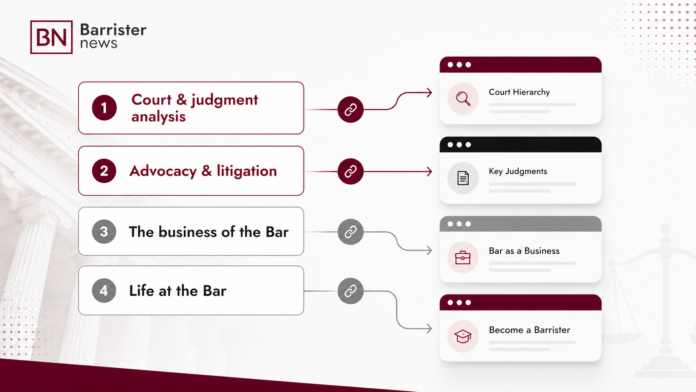


This is the Barrister News guide to the UK court system and the judgments it produces: how the courts of England and Wales are structured, how to read and use a judgment, how precedent binds, how appeals move, which decisions shaped the modern law, and where tribunals fit.
Everything the Bar does happens inside this machinery. A skeleton argument assumes the reader knows which authorities bind. An advice on appeal assumes the routes and the permission thresholds. This page is the map, written for practitioners first and readable by pupils, students and anyone who needs to understand how the system actually operates. It deals with England and Wales; Scotland and Northern Ireland run separate systems, and conflating the three is the most common error in coverage of “UK” courts.
Court & Judgment Analysis: the six things to understand
The subject breaks into six areas, and they build on each other: the structure of the courts, the craft of reading judgments, the doctrine of precedent, the appellate machinery, the landmark decisions, and the tribunal system alongside it all. The guides in each area are listed below. Guides already published are linked; the rest publish in sequence.
Court structure
5 guidesWhich courts exist, what each one does, and how work and authority move between them.
The UK court hierarchy explained
Every level of the system, from the Supreme Court to the magistrates’ courts, and the courts that sit outside the main ladder.
Supreme Court vs Court of Appeal vs High Court
What each senior court hears, who sits, and whose decisions bind.
The High Court divisions (KB, Chancery, Family)
The three divisions, their territories, and how the Divisional Courts are constituted.
Magistrates’ court vs Crown Court
How the two criminal courts divide the caseload, and the journey between them.
Where tribunals sit in the system
Why tribunals are part of the justice system but not the court hierarchy.
Reading judgments
5 guidesA judgment is a working document, and reading one well is a professional skill.
How to read a court judgment
Where to look first, and how to separate what decides the case from what discusses it.
Neutral citations explained (EWHC, EWCA Civ)
What the citation tells you before you read a word of the reasoning.
Ratio decidendi vs obiter dicta
Only the ratio binds. Isolating it is the skill.
How a judgment is structured
The recognisable anatomy: parties, issues, facts, law, analysis, disposal.
Reported vs unreported cases and law reports
The law reports hierarchy and when an unreported judgment can be cited.
Precedent & case law
4 guidesThe hierarchy exists to make precedent work: knowing when a court is bound, and when it can depart.
Binding precedent and stare decisis
The full doctrine, court by court.
When a court can depart from precedent
The 1966 Practice Statement, Young v Bristol Aeroplane, and per incuriam.
Persuasive vs binding authority
What persuades, what binds, and the special place of Privy Council decisions.
How case law develops
How the body of authority moves over time without legislation touching it.
Appeals
5 guidesAppeals generally move one rung up the ladder, and nearly all of them run through a permission stage.
How the appeals process works
From decision to disposal: time limits, permission, the test applied, and the powers on appeal.
Permission to appeal explained
Most appeals fail before they begin. This is where.
Routes of appeal by court
Where an appeal goes depends on the decision under challenge, not the subject matter.
Leapfrog appeals to the Supreme Court
When a High Court decision can bypass the Court of Appeal entirely.
Grounds of appeal explained
What makes a ground arguable, and the drafting habits that get grounds refused.
Landmark judgments
4 guidesSome decisions organise the law around themselves. Every practitioner carries a working set.
Landmark UK cases every practitioner should know
What each actually decided, rather than what it is remembered for.
Case-explained series
Our continuing analysis of individual judgments and what they change in practice.
How to analyse a judgment for practice impact
A working method for advising on what a new decision changes, for whom, from when.
How judges assess witness credibility
Demeanour, contemporaneous documents, and the fallibility of memory.
Tribunals
3 guidesTribunals decide an enormous share of disputes, in a parallel structure that converges with the courts at the top.
The tribunal system explained (First-tier and Upper)
The two-tier structure under the Tribunals, Courts and Enforcement Act 2007.
Employment Tribunal process explained
A claim from early conciliation to the Employment Appeal Tribunal.
Are tribunal decisions binding
Which tribunal decisions carry authority, and over whom.
Frequently asked questions
Where are UK court judgments published?
Judgments of the courts and tribunals of England and Wales from 19 April 2022 onwards are published on Find Case Law, the official service provided by The National Archives. Earlier judgments were published through various sources, including BAILII. The service is not a complete record, and coverage varies by court.
What is the difference between a judgment and a law report?
The judgment is the court’s own text, identified by its neutral citation. A law report is a published version of that judgment, sometimes with a headnote and editorial apparatus, produced by a report series. The two interact under practice directions that govern which version should be cited to a court.
Do tribunals follow the same rules as courts?
Tribunals apply the law but operate under their own procedural rules, which are generally less formal than court procedure. They sit in a parallel structure to the courts, and appeals from the Upper Tribunal and the Employment Appeal Tribunal can reach the Court of Appeal, at which point the ordinary appellate rules apply.
Related reading
- The UK court hierarchy explained
- UK appellate court decisions and what they mean for practice
- How judges assess witness credibility
- UK court reforms: the implications for barristers and chambers
New guides in this series are announced first in the Barrister News newsletter, alongside our reporting on the courts, the judiciary and the profession. Subscribe here.
This page is published for general information. It is not legal advice and should not be relied on as such.