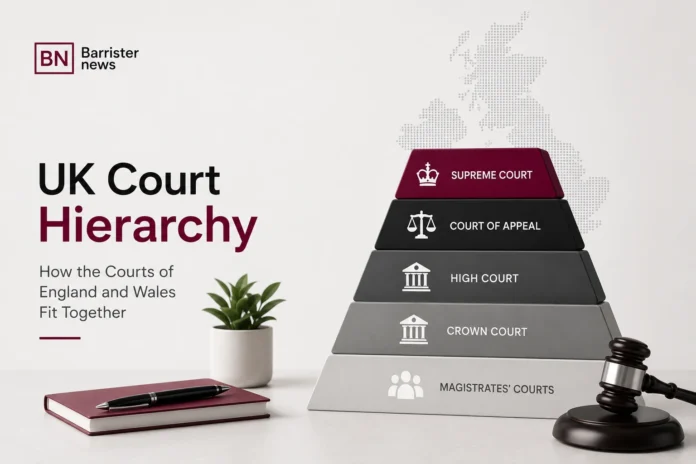


Search for the UK court hierarchy and you will find a diagram. A neat pyramid, magistrates at the bottom, the Supreme Court at the top, arrows running upward. It is a useful teaching aid and a poor description of how the courts actually work.
Two things go wrong. The first is in the name. There is no single UK court hierarchy, because there is no single UK court system. The second is the arrows. Appeal routes do not run up one rung at a time, and several of the most heavily used routes travel sideways or skip levels entirely.
This piece sets out the structure as it operates, which courts bind which, and what the hierarchy is actually for.
Start here: there is no UK court system
The United Kingdom does not generally have a unified legal system. England and Wales share one system, Scotland has another, and Northern Ireland a third , with constitutional matters committed to the UK Supreme Court. So the phrase “UK court hierarchy” describes three hierarchies that meet, incompletely, at the top.
The meeting point is qualified. The Supreme Court is the final court of appeal for civil cases across the whole United Kingdom, and for criminal cases originating in England, Wales and Northern Ireland. It is not the final criminal court for Scotland. That role belongs to the High Court of Justiciary, with no onward appeal, although the Supreme Court can still hear devolution and certain compatibility issues arising under the Scotland Act 1998.
Everything below is the structure of England and Wales. If your matter is Scottish or Northern Irish, the diagram does not apply, and neither does most of the precedent.
The criminal courts
Magistrates’ courts
Every criminal case starts in the magistrates’ court. Summary matters end there. Anything more serious is sent up to the Crown Court, either because the offence is indictable only or because the case is allocated upward.
The Crown Court
The Crown Court tries indictable matters before a judge and jury. It also sits as an appellate court: a defendant convicted in the magistrates’ court can appeal to the Crown Court, and that appeal takes the form of a rehearing rather than a review. New evidence can be called. This is the first place the pyramid misleads, because the Crown Court is simultaneously a trial court and an appeal court depending on how the case arrived.
Court of Appeal, Criminal Division
Appeals against conviction or sentence following trial on indictment go to the Criminal Division of the Court of Appeal, and from there, potentially, to the Supreme Court. The Lord Chief Justice heads this division.
The civil courts
The County Court
Most civil claims begin in the County Court. The route from there depends on the level of judge who decided the matter and the nature of the decision, which is why “appeals go up to the High Court” is only roughly true.
The High Court
The High Court has three divisions: King’s Bench, Chancery, and Family. Each is headed by its own senior judge. Alongside the Lord Chief Justice there are four Heads of Division: the Master of the Rolls, the President of the King’s Bench Division, the President of the Family Division, and the Chancellor of the High Court.
Within those divisions sit the specialist courts and lists that carry most heavyweight commercial work: the Technology and Construction Court, the Financial List, the Business List, the Insolvency and Companies List, the Competition List, the Intellectual Property List, the Revenue List, and the Property, Trusts and Probate List. A practitioner does not appear “in the High Court” in any meaningful sense. They appear in a list.
Court of Appeal, Civil Division
The Civil Division hears appeals in civil and family matters from the High Court, from tribunals, and from certain County Court cases. The Master of the Rolls heads it.
The Divisional Court, which the diagram usually omits
This is the rung most explainers skip, and it matters more than several they include.
Where a party says the magistrates got the law wrong, the ordinary route is not an appeal to the Crown Court. It is an appeal by way of case stated to the Divisional Court of the King’s Bench Division, under sections 111 to 114 of the Magistrates’ Courts Act 1980. The magistrates set out their findings of fact and pose a question of law for the High Court’s opinion. Two or three judges sit, and two must agree. The court can reverse, affirm or amend the decision, or send it back.
Sitting in its Divisional configuration, the King’s Bench Division hears appeals from magistrates’ courts, the Crown Court and various tribunals by way of case stated, together with judicial review and habeas corpus.
Case stated and judicial review overlap and are not interchangeable. Case stated is the ordinary route where the complaint is an error of law. Judicial review is the better fit where there is a factual issue the justices could not have decided for themselves, or an allegation about how the court conducted itself. And there is a hard boundary: sections 28(1)(a) and 29(3) of the Senior Courts Act 1981 shut out both case stated and judicial review for matters relating to trial on indictment.
Note what the hierarchy is doing here. A magistrates’ court decision can reach the High Court without ever passing through the Crown Court. The arrow goes sideways.
Tribunals sit alongside, not underneath
Tribunals are not the bottom of the court pyramid. They are a parallel structure with its own internal hierarchy: the First-tier Tribunal, divided into chambers, with the Upper Tribunal above it.
The connection to the courts comes at the top. Decisions of the Upper Tribunal chambers, and of the Employment Appeal Tribunal, can go to the Court of Appeal. So a tribunal case can end up in the same appellate court as a High Court claim, having never touched the County Court or the High Court on the way.
Jurisdiction is where this gets genuinely awkward. The courts structure covers England and Wales. The tribunals system covers England, Wales, and in some cases Northern Ireland and Scotland. Employment tribunals run as a single system across England, Wales and Scotland, but not Northern Ireland. Immigration and asylum jurisdiction runs UK wide. The tidy three-jurisdiction model does not survive contact with the tribunals.
The top of the structure
The Supreme Court has twelve permanent justices. It was created by the Constitutional Reform Act 2005 and took over from the Appellate Committee of the House of Lords, along with the devolution jurisdiction previously held by the Judicial Committee of the Privy Council.
The Privy Council still exists and still sits. It remains the final court of appeal for those Commonwealth countries that have retained the appeal. Its decisions are not part of the domestic hierarchy in the ordinary way, which is a distinction worth keeping straight when citing it.
The Court of Appeal, High Court, Crown Court, County Court and magistrates’ courts are administered by HM Courts and Tribunals Service, an executive agency of the Ministry of Justice. The Supreme Court is administered separately.
What the hierarchy is actually for
The structure is not an organisational chart. It is the mechanism that makes precedent work.
The higher courts, principally the Court of Appeal and the Supreme Court, carry a law making function, and their decisions bind the courts below them. That is the entire point of the ladder. Rank determines whose reasoning you must follow, whose you may cite as persuasive, and whose you can safely leave out of the bundle.
Which is why the hierarchy is not a matter of general knowledge for anyone who litigates. It is a working tool. Whether a decision binds you turns on the court, the division, the composition of the bench, and whether the passage you are relying on formed part of the reasoning necessary to the decision or was said in passing.
Reading a citation tells you where you are
A neutral citation encodes the court’s position in the hierarchy. It has four parts: the year in square brackets, the court acronym, the division acronym where the court has divisions, and a number allocated by that court within that year. EWCA is the Court of Appeal of England and Wales. Civ is the Civil Division.
One point of care. The neutral citation is the one allocated by the court, not a reference number issued by a publisher. Judgments and decisions of the courts and tribunals of England and Wales are published on Find Case Law, the official service run by The National Archives with the Ministry of Justice, HMCTS and the Judicial Office.
Absence from that service proves nothing. Coverage varies by court, and a great many decisions in the lower courts are given orally and never transcribed at all. The hierarchy contains far more decisions than the reported hierarchy does.
Frequently asked questions
What is the highest court in the UK?
The Supreme Court of the United Kingdom, for all UK civil cases and for criminal cases from England, Wales and Northern Ireland. Scottish criminal appeals end at the High Court of Justiciary instead, subject to devolution and compatibility issues.
Is there a single UK court hierarchy?
No. England and Wales, Scotland, and Northern Ireland each have their own system. The Supreme Court is a partial apex above all three rather than the top of one structure.
What are the divisions of the High Court?
King’s Bench, Chancery, and Family. Each contains specialist courts and lists, and each can sit as a Divisional Court.
Which court is above the Crown Court?
It depends on the route. Appeals from trial on indictment go to the Court of Appeal, Criminal Division. Appeals by way of case stated from the Crown Court’s own appellate decisions go to the Divisional Court of the King’s Bench Division. Matters relating to trial on indictment are excluded from both case stated and judicial review by the Senior Courts Act 1981.
Do tribunals sit below the courts?
Not underneath them. Tribunals form a parallel structure of First-tier and Upper Tribunal, and appeals from the Upper Tribunal and the Employment Appeal Tribunal go to the Court of Appeal.
Why does the court hierarchy matter in practice?
Because it determines binding precedent. The decisions of the higher courts bind the courts below, so a court’s rank governs whether its reasoning must be followed or merely considered.