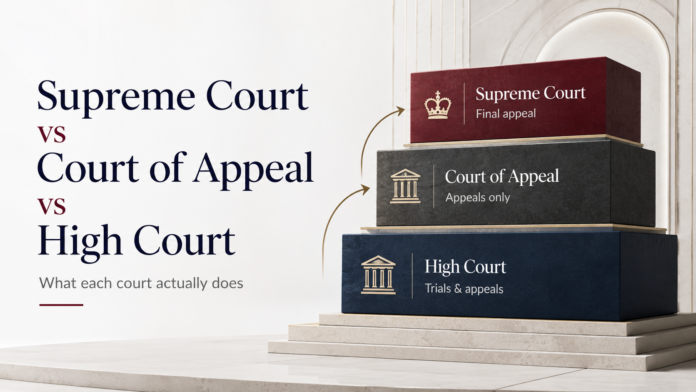


Supreme Court vs Court of Appeal vs High Court: the difference comes down to role. The UK Supreme Court is the final court of appeal, hearing a small number of cases raising points of law of general public importance. The Court of Appeal is the senior appellate court of England and Wales, hearing appeals only, across its Civil and Criminal Divisions. The High Court is both a trial court for the most substantial civil claims and an appellate and supervisory court for decisions made below it.
The three are confused constantly, including in national reporting, and the confusion is understandable: all three sit near the top of the structure, all three produce judgments that make news, and one of them does two jobs at once. This guide takes each court in turn, then sets out the differences that actually matter in practice: who sits, what they hear, how hard it is to get before them, and what weight their decisions carry. It is part of our Court & Judgment Analysis series; for where these three courts sit in the wider structure, start with the UK court hierarchy explained.
The three courts at a glance
| Supreme Court | Court of Appeal | High Court | |
|---|---|---|---|
| Role | Final court of appeal | Appeals only | Trials and appeals |
| Territory | Whole UK (civil); England, Wales and Northern Ireland (criminal) | England and Wales | England and Wales |
| Judges | Justices of the Supreme Court | Lords and Lady Justices of Appeal | Justices of the High Court |
| Typical panel | Five Justices; larger for major cases | Three judges | One judge; two or more as a Divisional Court |
| Entry threshold | Arguable point of law of general public importance | Permission: real prospect of success or other compelling reason (civil) | Issue at first instance, or appeal routes from below |
| Binding force | Binds every court below | Binds High Court and below, and ordinarily itself | Binds courts below; persuasive between High Court judges |
The UK Supreme Court: the final word
The Supreme Court consists of twelve Justices, led by a President and Deputy President, and hears appeals in panels: usually five, enlarged to seven, nine or more for cases of constitutional significance. It is the one court in this comparison whose reach extends beyond England and Wales. It is the final court of appeal for civil cases from the whole United Kingdom, and for criminal cases from England, Wales and Northern Ireland; Scottish criminal appeals end at the High Court of Justiciary, subject to narrow compatibility and devolution exceptions.
Getting there is the hard part. Under the Court’s own Practice Direction 3, permission is granted only for applications raising an arguable point of law of general public importance which ought to be considered by the Supreme Court at that time, bearing in mind that the matter has already been decided at least once and usually reviewed on appeal. Applications are considered by an Appeal Panel of three Justices, generally on the papers. In criminal cases there is a further gate: with narrow exceptions, the court below must certify that a point of law of general public importance is involved before an appeal can proceed at all.
The consequence is a court that decides a small number of cases and decides them for everyone. A Supreme Court judgment binds every court below it on the point decided, which is why a single appeal can reset an entire practice area, and why cases heading there attract attention long before they are heard. Our reporting on the Stonewall appeal is a current example.
The Court of Appeal: where most law gets made
The Court of Appeal sits only in England and Wales and hears nothing at first instance. It divides into a Civil Division, presided over by the Master of the Rolls, and a Criminal Division, presided over by the Lady Chief Justice. The Civil Division hears appeals from the High Court, the County Court and, in certain cases, the Upper Tribunal and the Employment Appeal Tribunal. The Criminal Division hears appeals against conviction and sentence from the Crown Court, and cannot determine an appeal against conviction with fewer than three judges.
Appeals are typically heard by three Lords or Lady Justices of Appeal, and any number of divisions of either division may sit at the same time. That is the structural point most explanations miss: the Court of Appeal is not one courtroom but many sitting in parallel, which is how it disposes of a caseload vastly larger than the Supreme Court’s. In terms of the law practitioners actually apply day to day, most of it is settled here, not at the apex. Our analysis of recent appellate decisions tracks how quickly that output reaches practice.
Entry is gated by permission. In civil cases, the test is whether the appeal has a real prospect of success or there is some other compelling reason for it to be heard, sought first from the court below or from the Court of Appeal itself. The threshold is real but achievable, and it is the heart of the Supreme Court vs Court of Appeal comparison: the Court of Appeal exists to correct error, the Supreme Court to settle the law.
The High Court: the court that does two jobs
The High Court is the reason this comparison needs a third column. Unlike the two courts above it, it is primarily a trial court: the venue for the most substantial and complex civil claims, sitting in three divisions, King’s Bench, Chancery and Family, each with its own territory and specialist courts. A commercial fraud claim, a contested probate dispute and an international child abduction case are all High Court work, tried by a single Justice of the High Court.
But it is also an appellate and supervisory court. It hears appeals from courts and tribunals below it, and through the Administrative Court it exercises judicial review over public bodies, including the magistrates’ courts. When two or more of its judges sit together, the court is a Divisional Court, the formation that hears appeals by case stated and the most significant judicial review claims. A first-instance High Court judgment binds the courts below it, though not other High Court judges, for whom it is persuasive.
So the practical distinction is this: you litigate in the High Court, you appeal to the Court of Appeal, and you reach the Supreme Court only if your case raises a question the whole jurisdiction needs answered.
Supreme Court vs Court of Appeal vs High Court: the differences that matter
Jurisdiction and reach
The Court of Appeal and High Court are courts of England and Wales. The Supreme Court serves the whole UK in civil matters, which means its judgments must sometimes reconcile positions across three legal systems, a dimension entirely absent from the courts below it.
Volume and selectivity
The three courts form a filter. The High Court tries and decides at scale. The Court of Appeal reviews a substantial fraction of that output for error. The Supreme Court selects a small number of questions and answers them for everyone. Each step up trades volume for finality.
Permission thresholds
The gates get progressively narrower. Reaching the Court of Appeal requires a real prospect of success or another compelling reason. Reaching the Supreme Court requires a point of law of general public importance, and in criminal cases a certificate from the court below. Losing in the Court of Appeal is, for the overwhelming majority of litigants, the end.
Weight of decisions
A Supreme Court judgment binds every court. A Court of Appeal judgment binds the High Court and everything below it, and ordinarily the Court of Appeal itself, subject to the recognised exceptions. A High Court judgment binds the courts below but only persuades other High Court judges. Same hierarchy, three different currencies of authority, which is why the court name in a neutral citation matters before a word of the judgment is read.
How one case can pass through all three
Take a substantial commercial claim. It is tried in the King’s Bench Division before a single judge, who gives judgment. The losing party seeks permission to appeal, shows a real prospect of success, and the case is reheard on the law by three judges in the Civil Division of the Court of Appeal. The losing party there identifies a point of law of general public importance, and an Appeal Panel of three Justices grants permission for a final appeal before five Justices of the Supreme Court, whose decision then binds every court in the jurisdiction, including both courts that heard the case before them.
Most cases complete none of that journey, and a small class skip a step: under the leapfrog provisions of the Administration of Justice Act 1969, certain High Court decisions can be appealed directly to the Supreme Court, bypassing the Court of Appeal entirely.
Frequently asked questions
What is the difference between the Supreme Court and the Court of Appeal?
The Supreme Court vs Court of Appeal difference is one of function and finality. The Court of Appeal corrects errors in decisions of the courts of England and Wales and handles the far larger caseload. The Supreme Court settles points of law of general public importance for the whole UK, and its decisions bind the Court of Appeal.
Is the Supreme Court higher than the Court of Appeal?
Yes. The Supreme Court is the final court of appeal, and its decisions bind the Court of Appeal and every court below it. The Court of Appeal is the senior appellate court within England and Wales, sitting below the Supreme Court in the hierarchy.
What is the difference between the High Court and the Supreme Court?
The High Court is mainly a trial court, where substantial civil cases are heard for the first time by a single judge. The Supreme Court hears no trials; it is the final court of appeal, deciding a small number of cases that raise points of law of general public importance. A case can only reach the Supreme Court after it has been decided below.
Can you appeal from the Court of Appeal to the Supreme Court?
Yes, with permission, which is granted only where the appeal raises an arguable point of law of general public importance which ought to be considered by the Supreme Court at that time. In criminal cases, with narrow exceptions, the court below must also certify that such a point is involved. Permission is refused in the majority of applications, and a refusal is final.
How many judges sit in each court?
A High Court trial is heard by a single judge, or by two or more sitting as a Divisional Court. Court of Appeal cases are typically heard by three judges. The Supreme Court usually sits as a panel of five of its twelve Justices, with larger panels for cases of particular importance.
If you keep one thing from this guide, the Supreme Court vs Court of Appeal vs High Court comparison reduces to three verbs: the High Court decides, the Court of Appeal corrects, the Supreme Court settles.