

Quick look
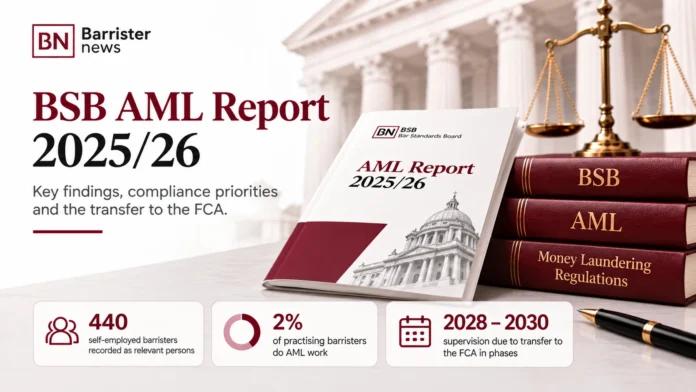
The BSB AML report for 2025/26 was published on 29 October 2026. It records 440 self-employed barristers and seven BSB entities as relevant persons under the Money Laundering Regulations, and estimates that only 2% of practising barristers undertake work in scope. Supervisory responsibility is due to transfer to the Financial Conduct Authority in phases between 2028 and 2030.
The Bar Standards Board (BSB) has published its BSB AML report for 2025/26, setting out its anti-money laundering supervision work and highlighting compliance priorities for barristers and regulated entities ahead of the planned transfer of supervisory responsibility to the Financial Conduct Authority (FCA).
Published on 29 October 2026, the report reviews the BSB’s work under the Money Laundering Regulations (MLRs), including risk assessments, compliance monitoring, potential breaches and engagement with other regulatory bodies.
The report is itself a regulatory requirement. Regulation 46A of the MLRs obliges supervisors to publish an annual report on their supervision activity, the encouragement of reporting of actual or potential breaches, and the measures taken to monitor and enforce compliance.
Which barristers have to declare AML work?
Barristers must declare when renewing their practising certificates whether they undertake work falling within the scope of the MLRs. BSB entities must make the same declaration when authorised and during annual renewal.
The report records 440 self-employed barristers, seven BSB entities and eight beneficial owners, officers and managers of BSB entities as relevant persons in 2026.
The BSB estimates that only 2% of practising barristers and 4% of BSB entities undertake work covered by the regulations. This typically includes tax advisory services and certain types of property and trust work.
The figure has been broadly stable. The equivalent report for 2024/25 recorded 441 self-employed barristers, following 461 in 2024 and 478 in 2023.
What did the BSB find on declarations and risk assessments?
The regulator highlighted the importance of accurate declarations and documented practice risk assessments.
In 2025, the BSB selected 32 barristers who had declared that they undertook work within the scope of the MLRs and asked them to submit their practice risk assessments. Of those, 28 confirmed that their declarations were inaccurate because they did not undertake work covered by the regulations. The remaining four complied with the requirement to document and maintain a practice risk assessment.
The number worth pausing on. Of 32 barristers who had told the regulator they did work in scope, 28 had declared inaccurately. That is a declaration accuracy problem rather than a compliance failure by those actually doing the work, and it affects the reliability of the population figures the regulator supervises against.
Under Regulation 18 of the MLRs, relevant persons must identify and assess the money laundering and terrorist financing risks associated with their practice. This assessment must consider factors including customers, geographical areas, services, transactions and delivery channels.
What supervisory action did the BSB take?
The report also outlines the BSB’s enforcement and supervisory figures for 2025/26. Two cases resulted in supervisory action, while no cases resulted in enforcement action or the disbarment of a barrister under the reported categories.
During 2026, the BSB conducted supervision visits to two chambers specialising in property work. The visits examined barristers’ understanding of the regulations, customer due diligence procedures and case risk assessments. The regulator reported that both chambers complied with their obligations and that no supervisory action was required.
The BSB also emphasised the role of chambers in supporting compliance. Although chambers are not themselves authorised entities under the MLRs, their staff play an important role in helping barristers understand their obligations and maintain appropriate controls.
The BSB’s own supervisory duties sit within the regulations as well. It is required to adopt a risk-based approach to supervision under Regulation 17, and to approve self-employed barristers and the owners and managers of BSB entities carrying out work under the regulations under Regulation 26. Its performance in doing so is overseen by the Office for Professional Body AML Supervision, which is based within the FCA.
When does the FCA take over AML supervision?
The report confirms that the Government intends to establish the FCA as the single professional services supervisor for anti-money laundering and counter-terrorist financing purposes.
That decision followed an HM Treasury consultation begun in 2023, with the outcome announced on 21 October 2025.
Once the required legislation is in place, the FCA will assume responsibility for supervising legal, accountancy and trust and company service providers. Barristers and BSB entities undertaking work within the scope of the MLRs will consequently fall under FCA supervision and enforcement for that aspect of their practice.
The practical consequence is dual regulation for those affected. The FCA would supervise AML and counter-terrorist financing compliance, while the BSB would continue to regulate professional conduct and all other aspects of practice under the BSB Handbook.
The transition is expected to take place in phases between 2028 and 2030. The BSB and FCA have already begun working together on preparations.
What happens next?
For 2026/27, the BSB plans to continue compliance testing, supervise barristers and entities registered as Authorised Corporate Service Providers, conduct Regulation 18 risk assessment spot checks and respond to reports of potential breaches.
The report sets out the regulator’s continuing supervisory priorities while preparations for the transfer of responsibility progress.
This article is information and analysis, not legal advice. Barristers and entities who may undertake work within the scope of the Money Laundering Regulations should refer to the BSB’s anti-money laundering guidance and the regulations themselves.
Key takeaways
- The BSB published its AML annual report for 2025/26 on 29 October 2026, as required by Regulation 46A of the MLRs.
- 440 self-employed barristers, seven BSB entities and eight beneficial owners, officers and managers were recorded as relevant persons in 2026.
- Only an estimated 2% of practising barristers and 4% of BSB entities do work within scope, typically tax advisory and some property and trust work.
- Of 32 barristers asked for practice risk assessments, 28 confirmed their declarations had been inaccurate.
- Regulation 18 requires relevant persons to identify and assess risks across customers, geography, services, transactions and delivery channels.
- Two cases resulted in supervisory action in 2025/26, and no cases led to enforcement action or disbarment under the reported categories.
- Supervision visits to two property chambers found both compliant with no action required.
- AML supervision transfers to the FCA in phases between 2028 and 2030, following the HM Treasury decision announced on 21 October 2025.
Frequently asked questions
What is the BSB AML report?
The Bar Standards Board’s annual report on its anti-money laundering supervision of barristers and BSB entities. The 2025/26 edition was published on 29 October 2026.
How many barristers do work covered by the Money Laundering Regulations?
The report records 440 self-employed barristers as relevant persons in 2026, and the BSB estimates that only 2% of practising barristers undertake work in scope.
What kind of work falls within the MLRs?
Typically tax advisory services and certain types of property and trust work.
What is a practice risk assessment?
An assessment required by Regulation 18 of the MLRs identifying the money laundering and terrorist financing risks of a practice, taking account of customers, geographical areas, services, transactions and delivery channels.
Do barristers have to declare AML work to the BSB?
Yes. Barristers declare on practising certificate renewal whether they undertake work within the scope of the MLRs, and BSB entities declare on authorisation and at annual renewal.
When will the FCA take over AML supervision from the BSB?
In phases between 2028 and 2030, once the required legislation is in place. The FCA will become the single professional services supervisor for the legal and accountancy sectors and trust and company service providers.
Will the BSB still regulate barristers after the FCA transition?
Yes. The FCA would supervise AML and counter-terrorist financing compliance, while the BSB continues to regulate professional conduct and all other aspects of practice.
Are chambers regulated under the Money Laundering Regulations?
Chambers are not themselves authorised entities under the MLRs, though the BSB notes that chambers staff play an important role in supporting barristers’ compliance.